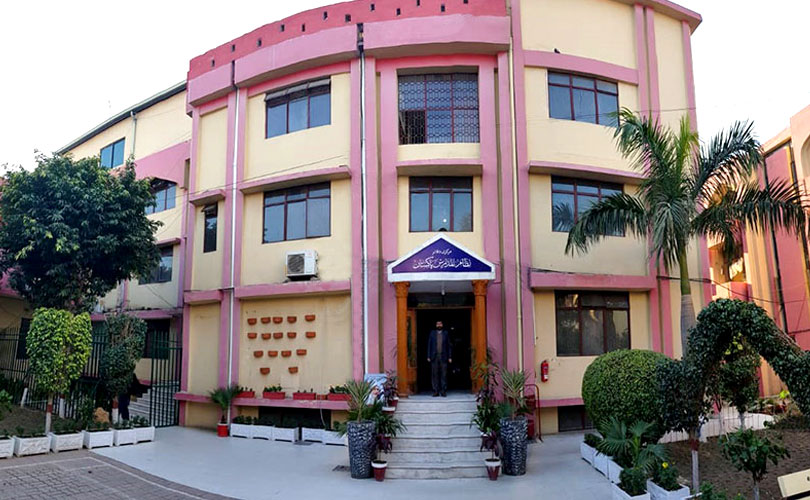
Nizam-ul-Madaris Pakistan is a nationally recognized religious education board established under the intellectual, scholarly, and ideological guidance and leadership of Shaykh-ul-Islam Dr Muhammad Tahir-ul-Qadri, founding leader and Patron-in-Chief of Minhaj-ul-Quran International. Its educational foundations are rooted in Jamia Islamia Minhaj-ul-Quran, established in Lahore in 1986 with the vision of integrating classical Islamic scholarship with contemporary knowledge and producing scholars capable of addressing modern challenges in the light of the Qur’an and Sunnah.
The academic services of Jamia Islamia Minhaj-ul-Quran received formal recognition when the University Grants Commission (UGC) authorized it in 1992 to award Master's-level qualifications equivalent to MA in Arabic and Islamic Studies, a recognition subsequently endorsed by the Higher Education Commission (HEC) in 2003. In acknowledgment of more than three decades of distinguished educational services, the Federal Ministry of Education and Technical Training, Government of Pakistan, formally approved the establishment of Nizam-ul-Madaris Pakistan on 4 February 2021.
Nizam-ul-Madaris Pakistan seeks to reform and strengthen religious education by combining the authentic traditions of Islamic learning with modern academic disciplines, technology, vocational education, social sciences, and linguistic proficiency. Its educational philosophy is founded upon the Qur’anic and Prophetic values of moderation, tolerance, peace, unity, compassion, moral excellence, and service to humanity.
The institution is committed to developing scholars and students who possess sound religious knowledge, intellectual maturity, spiritual character, professional competence, and a strong sense of social and national responsibility. Through curriculum development, teacher training, institutional improvement, contemporary education, and the promotion of peaceful and balanced Islamic thought, Nizam-ul-Madaris Pakistan aims to prepare a generation capable of providing meaningful religious and intellectual leadership in contemporary society.
A central objective of the institution is to protect religious education from extremism, sectarianism, violence, intolerance, and ideological polarization, while promoting dialogue, interfaith and inter-sect harmony, responsible citizenship, patriotism, and peaceful coexistence. It also works to equip students with knowledge of English, Arabic, computer sciences, social sciences, mathematics, general sciences, and vocational skills so that graduates can contribute effectively to religious, educational, social, and economic development.
Through the establishment and development of quality religious institutions across Pakistan, Nizam-ul-Madaris Pakistan aspires to create a progressive, balanced, academically strong, and socially responsible system of religious education that remains firmly connected to the Islamic scholarly tradition while responding effectively to the needs of the modern world.